Houston Slip and Fall Lawyer
Dangerous property conditions and inadequate security.
Free Case Review
No fee unless we win. Tell us what happened — we respond fast, 24/7.
A fall sounds minor until it happens to you. A moment on a wet grocery-store floor or a broken apartment stairway can mean a fractured hip, a torn shoulder, a traumatic brain injury — and months of treatment for something that took two seconds. Texas premises liability law holds property owners responsible when they let dangerous conditions injure the people they invited in. But these are among the most aggressively defended injury claims in Texas, and the property owner starts gathering its side of the story the moment you hit the floor.
RK LAW handles slip and fall and premises liability claims throughout the Houston area on a contingency-fee basis. Talk to a Houston slip and fall lawyer today: the consultation is free, we are available 24/7, and you pay no attorney's fee unless we recover for you.
What a Property Owner Owes You Depends on Why You Were There
Texas premises liability law starts with your visitor status. An invitee — a customer in a store, a tenant in a common area, anyone on the property for the owner's benefit — is owed the highest duty: the owner must use reasonable care to inspect for unreasonably dangerous conditions and either fix them or adequately warn about them. A licensee, such as a social guest, is owed less: the owner must not injure them through gross negligence and must warn of known dangers. A trespasser is owed almost nothing beyond not being intentionally harmed.
Most Houston slip and fall claims involve invitees — shoppers at grocery stores and big-box retailers, restaurant patrons, apartment tenants, hotel guests. For an invitee to recover, Texas law requires proof that a condition on the property posed an unreasonable risk of harm, that the owner knew or should have known about it, that the owner failed to fix it or warn of it, and that the condition caused the injury. Each element is contested, and one of them is fought harder than all the others combined.
Notice: The Element That Wins or Loses These Cases
The hardest element in a Texas premises case is knowledge — proving the owner knew or should have known about the hazard. Actual knowledge means the owner or its employees knew: an employee saw the spill, a prior complaint was logged, a work order sat unaddressed. Constructive knowledge means the hazard existed long enough that a reasonable owner would have discovered it — the puddle with cart tracks and footprints through it, the drink dried at the edges, the stair that had been loose for months.
This is exactly where store defense teams concentrate their fire: we had no idea it was there, so it must have appeared moments before you fell. Beating that defense takes evidence — surveillance footage showing how long the hazard sat there, inspection and sweep logs showing when the area was last checked (or that the store skipped its own schedule), employee statements, and prior incident records showing the owner had seen this problem before. Building that proof is the core of what we do in these cases.
Common Hazards on Houston Properties — Including Negligent Security
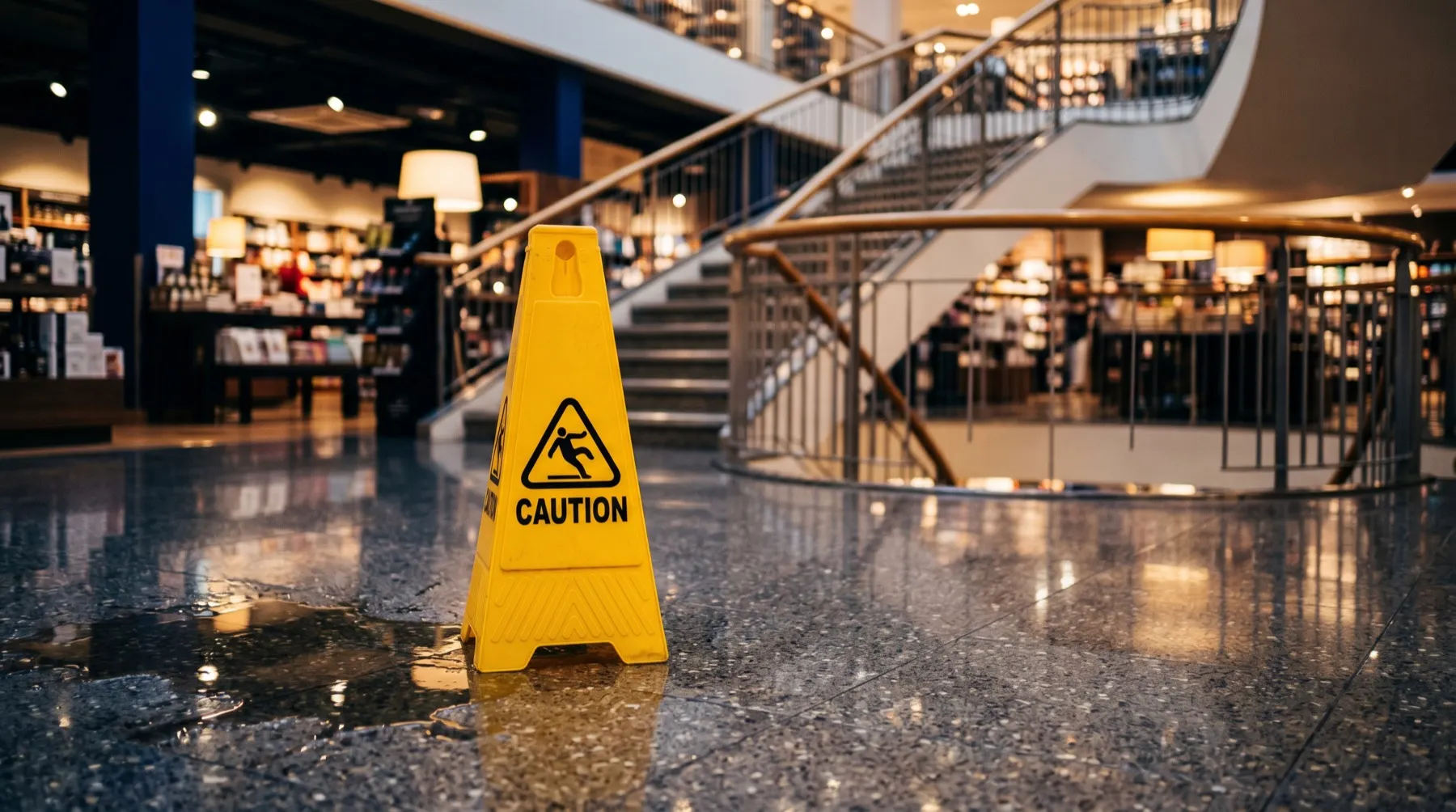
The dangerous conditions we see across Houston repeat themselves: wet and freshly mopped floors without warning cones, spills left standing in grocery and restaurant aisles, broken or uneven stairs and missing handrails at apartment complexes, torn carpet and unmarked elevation changes, poor lighting in stairwells and corridors, and cracked, flooded, or pothole-ridden parking lots — a constant hazard in a city with Houston's rain.
Premises liability also covers a danger that isn't a spill or a stair: other people. When an apartment complex, parking garage, bar, or shopping center knows about foreseeable criminal activity — prior assaults, robberies, break-ins on or near the property — and fails to take reasonable security measures like working gates, adequate lighting, functioning cameras, or security personnel, a person attacked there may have a negligent security claim against the property owner. These cases turn on foreseeability and on what the owner knew about the area's crime history.
Why the Evidence Disappears Faster Than Your Injuries Heal
In a premises case, the defendant owns the accident scene — and the evidence. Surveillance systems typically overwrite footage on a cycle, sometimes within days or weeks. Incident reports are written by the store's employees for the store's benefit. Sweep logs, inspection records, maintenance histories, and prior-incident files all sit in the owner's hands, and the hazard itself is usually mopped up, repaired, or repainted within hours of your fall.
That is why the first thing we do is send a preservation letter demanding the owner retain the footage, logs, and reports before routine destruction erases them. If you can, help your own case in the first minutes and days: photograph the hazard and your footwear, report the fall and ask for the incident report number, get names of witnesses and employees, and see a doctor the same day. Then get a lawyer involved before the camera footage is gone — that window can be shockingly short.
The Comparative Fault Defense — and the Two-Year Deadline
The standard defense in every Texas fall case is that you were the careless one: you weren't watching where you walked, the hazard was open and obvious, your shoes were the problem. Texas's modified comparative fault rule gives that strategy teeth — your recovery is reduced by your percentage of fault, and if a jury puts more than half the blame on you, you recover nothing. Countering it takes the same evidence that proves notice: footage, photos, lighting conditions, and the absence of warnings.
The deadline is unforgiving too. Texas generally allows two years from the date of injury to file suit (Tex. Civ. Prac. & Rem. Code § 16.003), with shorter notice requirements — sometimes a few months — when the property is government-owned, like a city sidewalk or county building. (This is general information, not legal advice about your specific deadline.) With RK LAW, the consultation is free and you pay no fee unless we win — so there is no reason to wait while the evidence disappears.
You may be entitled to compensation for:
- Medical bills
- Lost wages
- Pain & suffering
- Future care
Slip & Fall / Premises Liability FAQs
How much does a slip and fall lawyer cost in Houston?
Nothing up front. RK LAW handles premises liability cases on a contingency fee — no attorney's fee unless we recover compensation for you. The consultation is free and we are available 24/7.
How long do I have to file a slip and fall claim in Texas?
Generally two years from the date of the injury under Tex. Civ. Prac. & Rem. Code § 16.003. If the fall happened on government property, notice deadlines can be as short as a few months. Contact an attorney promptly to protect your specific deadline.
The store says it didn't know about the spill. Do I still have a case?
Possibly. Texas law lets you prove constructive knowledge — that the hazard existed long enough that the owner should have discovered it. Surveillance footage, sweep logs, and the condition of the spill itself (dried edges, track marks) can establish it. That evidence disappears fast, which is why early investigation matters.
I fell but didn't feel hurt until days later. Is that a problem?
It's common — adrenaline masks injuries, and conditions like herniated discs and concussions often surface over days. See a doctor as soon as symptoms appear and tell them about the fall. Delayed treatment gives the insurer an argument, but it does not end your claim.
I was attacked in my apartment complex parking lot. Is that a premises case?
It may be. If the property owner knew about foreseeable criminal activity — prior assaults or break-ins on or near the property — and failed to provide reasonable security like working gates, lighting, or cameras, Texas law recognizes a negligent security claim against the owner.
What if the property owner blames me for the fall?
Expect it — comparative fault is the standard defense. Under Texas law you can still recover if you were 50% or less at fault, with your compensation reduced by your percentage. Evidence like camera footage, photos, and missing warning signs is how we push back on inflated blame.
These answers are general information, not legal advice. Get a free case review for advice about your situation.
Ready to talk? It's free.
Get a free, no-obligation case review from a Houston Slip and Fall Lawyer. There's no fee unless we win.